Jan 29, 2010

Pakistan offers training to Afghanistan army and police: Qureshi


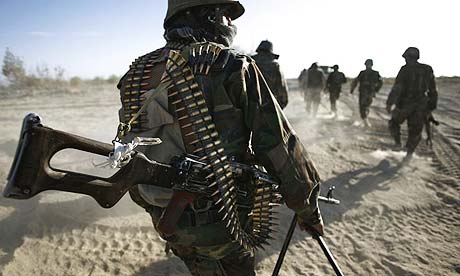
LONDON: Foreign Minister Shah Mehmood Qureshi said that Pakistan has offered training to Afghanistan army and police and also offered to increase cooperation in various fields with Afghanistan. 

Talking to a private TV channel He said that in the conference the importance of Pakistan was admitted and besides military options, other options for the solution of Afghanistan issue were also discussed." We would have to move forward by keeping the ground realities in mind, " adding, " the Afghanistan government has sought help from Pakistan and Saudi Arab in talks with Taliban". 

Qureshi said that Afghanistan has to prepare 0.3 million army and police officials by 2011.
"According to Pakistan point of view, the conference was very successful and addressing our reservations in it is our great success", he added. He said that Hamid Karzai has sought five years time for normalizing the situation in his country. 

British Prime Minister Gordon Brown said the international conference in London on Afghanistan’s future, marked a "decisive" moment in Afghanistan’s history.

While he warned that British and international troops fighting the Taliban would face more "tough times" ahead, he said a process was being put in place that would enable them to return home.

"It will take time but I believe that the conditions set out in the plan that we will sign up to today can be met sooner than many expect and, as a result, the process of handover district-by-district will begin later this year," he said Speaking to a 60-nation conference in London.

"It will mark the beginning of a new phase and a decisive step towards Afghans taking responsibility for their own security."

Mr Brown backed President Hamid Karzai’s plan to re-integrate Taliban fighters who are prepared to lay down their arms and renounce violence. 

"As an international community responding to President Karzai’s leadership, we are today establishing an international trust fund to finance this peace and re-integration programme to provide an economic alternative to those who have none," he said.

"But for those insurgents who refuse to accept the conditions for re-integration, we have no choice but to pursue them militarily."

In his opening address, Mr Karzai said a national council for peace, reconciliation and re-integration would be established in Afghanistan.
Afghan President Hamid Karzai called on Saudi Arabia on Thursday to play a prominent role in bringing peace to Afghanistan.He said he would call a loya jirga, or council of elders, to discuss how to bring about reconciliation in Afghanistan. 

"We will establish a national council for peace and reconciliation and reintegration, followed by a peace jirga in Afghanistan," he said. "We hope His Majesty (Saudi) King Abdullah bin Abdul-Aziz will kindly play a prominent role to guide and assist the peace process."
Karzai also said stability in Afghanistan depended not just on what happened inside the country but also on its neighbours. "We ask all our neighbours, particularly Pakistan, to support our peace and reconciliation effort," he said. He also urged Afghan insurgents to sever ties with al Qaeda.
The Afghan Foreign minister of Afghanistan Rangeen Dadfur Spanta has termed the, establishing of peace in Afghanistan as a great challenge.

UK Secretary of State for Foreign and Commonwealth Affairs David Miliband has also announced U$. 140 million dollars for Afghanistan. He said that the aim of the conference was to unite the neighboring countries of Afghanistan.

He elaborated that the situation of Pakistan and Afghanistan were different from each other. And said that more powers would have to be given to Afghan people, as the poor prevalent situation could be improved with dialogue and not only by war.
However, the Taliban have rejected the declaration of London conference, saying, it was nothing more than a western propaganda. 

Mullah Zaeef said that relieving the occupation of Afghanistan by foreign forces was the first priority, and stressed that US would have to leave Afghanistan.


Source: http://www.onlinenews.com.pk/details.php?id=157894

Jan 20, 2010

Govt decides to expand Pak missile program


Upadated on: 20 Jan 10 09:29 PM

Staff Report

ISLAMABAD: The government has decided to expand its nuclear program, sources told SAMAA on Wednesday.


The government has asked the Finance Ministry tto provide funds to upgrade the missile program of the country.

Prime Minister Syed yousuf Raza Gilani presided the meeting of the strategic planing division on January 19, 2010. Finance Minister Shaukat Tareen, Chairman Joints Chief of Staff Committee General Tariq Majeed and Director General Strategic and Planning Division also joined the meeting, sources added.

The members of the meeting approved to supgrade the missile program of the country to maintain balance of power in the region, sources added.

The Finance Ministry has been instructed to provide resources for upgradation of the missile program, sources added. SAMAA


Source: http://www.samaa.tv/News16344-Govt_decides_to_expand_Pak_missile_program.aspx


Jan 17, 2010

Pakistan, China to enhance military cooperation


Prime Minister Yousaf Raza Gilani talking to China’s Deputy Chief of the People’s Liberation Army General Staff, General Ma Xiaotian. – APP (Picture from Dawn.com)


Chinese Defense Minister Liang Guanglie (R) meets with Noman Bashir, visiting Pakistani chief of the naval staff, in Beijing, Dec. 18, 2009. (Xinhua/Zhang Duo)


Sunday 17 Jan 2010


Islamabad, Jan 17 : Pakistan and China have inked an agreement for further strengthening defence production, staging joint military exercises and training military officers.

Quoting sources, Online news agency reported Sunday the agreement was signed during the visit here of Chinese Deputy Chief of General Staff Gen. Ma Xiaotian.

Under the agreement, Pakistan and China have agreed that both countries would work jointly for strategic stability in the region and to enhance cooperation between institutions of defence production, the sources said.

It was also agreed that both countries would also ensure the implementation of memorandums of understanding signed in the past on the supply of latest planes and ships and any obstacles in the way would be removed through talks.

The sources further said that both countries agreed on the training of soldiers and frequent visits of senior military officers and contacts between them, adding that the agreement will have far-reaching impact on the relations between the two countries.

Pakistan-China relations began in 1950 when this country was among the first to break ties with Taiwan and recognise the People's Republic of China.

Following the Sino-Indian hostilities of 1962, Pakistan's relations with China became stronger. Since then, the two countries have regularly exchanged high-level visits, resulting in a variety of agreements.

The relationship has been described by Chinese President Hu Jintao as "higher than the mountains and deeper than the oceans".

Of late, military cooperation has deepened with joint projects producing armaments ranging from fighter jets to guided missile frigates.

Copyright Indo Asian News


Source: http://www.littleabout.com/news/58891,pakistan-china-enhance-military-cooperation.html

Dec 21, 2009

Wanted For Treason Poster


New "Wanted for Treason" Poster, made by me.

Dec 18, 2009

Supreme Court cracks down on corrupt Politicians

Pakistan Ministers Are Called Before the Courts


By JANE PERLEZ and SALMAN MASOOD
Published: December 18, 2009

ISLAMABAD, Pakistan — A sweeping Supreme Court decision that reopened corruption cases against thousands of politicians, including President Asif Ali Zardari, reverberated through the government Friday as important ministers were barred from leaving the country and ordered to appear before the courts in the coming weeks.

Among those immediately affected were the interior minister, Rehman Malik, who is considered particularly close to the United States, and the Defense Minister, Ahmed Mukhtar, raising concerns about how effectively the Zardari government, under pressure from a violent Islamic insurgency, could continue to function.

The two men were among 247 officials, also including Salman Farooki, the chief of staff to Mr. Zardari, placed on what is known as an exit control list, barring them from leaving Pakistan, a measure Pakistan authorities often use to ensure those under criminal investigation do not abscond.

At least 52 politicians were called to appear before corruption courts, according to the National Accountability Bureau, the anticorruption unit that was ordered by the Supreme Court on Wednesday to act expeditiously in reopening the cases.

By the end of Friday, Mr. Farooki had won an interim bail order from the Sindh High Court, a measure that would prevent him from being arrested, legal experts said.

Mr. Malik had also been ordered to appear before the Sindh High Court, according to a report on Express television. Attempts to reach a spokesman for Mr. Malik were unsuccessful.

The Constitution allows President Zardari enjoys immunity under the Constitution from prosecution. He remained defiant Friday against calls from the main opposition party that he step down.

Moreover, he had no intention to ask cabinet ministers or colleagues facing corruption charges to quit either, a media adviser, Farahnaz Ispahani, said Friday.

“The president is fighting fit,” Ms. Ispahani said. “The president was clear that our Pakistan Peoples Party ministers would not be asked to resign merely on the basis of accusation.”

A cabinet reshuffle in which “some people will be out and some will be moved,” would be the main response to the revocation of the amnesty by the Supreme Court, Ms. Ispahani said.

But as Mr. Zardari and his party, the Pakistan Peoples Party, the biggest in Pakistan, battled to survive, a groundswell of media and public opinion seemed to exult in the decisiveness of the Supreme Court decision, which suggested there would no longer be a tolerant attitude toward corruption among politicians in Pakistan.“We’ve never seen the mighty in this country held accountable,” said Babar Sattar, a Harvard-trained constitutional lawyer.

Now that the court, backed by public opinion, had come down hard on corruption in a way not seen before in Pakistan, the affected politicians were not sure how to react, Mr. Sattar said.

There was no sign Friday that the army, which has been increasingly at odds with Mr. Zardari, was aiming to take control.

Behind the scenes, the army has been critical of Mr. Zardari, in part because of the president’s early move to put a civilian in charge of the country’ premier spy agency, the powerful Inter-Services Intelligence agency, and in part because of his gestures of conciliation toward India, Pakistan’s archenemy.

The army has also grown increasingly wary of Mr. Zardari as an aura of corruption has continued to mount around his government.

The reputation of the army, stained after the president and military chief at the time, Gen. Pervez Musharraf, imposed emergency rule in November 2007, has grown in the past few months as it fights Taliban militants, and it would benefit further because of the severity of the Supreme Court decision against the civilian government, analysts said.

Many of the corruption cases that the Supreme Court said must be reopened originate from the 1990s, including cases against Mr. Zardari, who served 11 years in jail. Mr. Zardari contends he was never convicted, a signal he and his supporters say shows his innocence.

Lawyers affiliated with the opposition party Pakistan Muslim League and some legal experts dispute Mr. Zardari’s insistence that he was not convicted, citing a conviction in Switzerland that Mr. Zardari appealed.

That case was withdrawn by the Pakistani government in 2007 under the provisions of the amnesty against corruption cases imposed by General Musharraf, who later resigned his military post. Lawyers affiliated with the Muslim League also insist that Mr. Zardari carries a conviction for failing to appear when ordered to do so by the Lahore High Court after he left the country in 2004.

In its ruling Wednesday, the Supreme Court said the Musharraf government had acted improperly in withdrawing the case in Switzerland. It asked the Swiss authorities to resume the proceedings. Swiss officials backed away from the Supreme Court’s demand, saying Thursday the case would not be reopened unless Pakistan started proceedings against Mr. Zardari.

In tackling the issue of corruption, the Supreme Court, led by Chief Justice Iftikhar Muhammad Chaudhry, who likes to see himself as the “people’s judge” has gone beyond rolling back the amnesty on individual corruption cases.

This week, the court also took exception to the government removing the chief of the country’s main investigative agency.

In a separate ruling from lifting the amnesty, the court ordered the government to reinstate, the head of the Federal Investigations Agency, Tariq Khosa, who had been dismissed by Prime Minister Yousaf Raza Gilani .

Mr. Khosa, who was described in the Pakistani press as the country’s toughest corruption fighter, was removed from his job earlier this month while he was in the midst of investigating why the government-run Pakistan Steel Mill had suddenly lost large amounts of money during the first 15 months of Mr. Zardari’s tenure.

The mill, the biggest in the country, had made steady profits in the previous eight years.

Source:  http://www.nytimes.com/2009/12/19/world/asia/19pstan.html


This is perhaps a turning point for Pakistan, an independent judicial system/Supreme Court holding corrupt politicians accountable, the essence of every great nation. This is what many Pakistanis have been waiting for.